Thornton, CO Neighborhood Guide: What to Know Before You Move

Thornton, CO Neighborhood Guide: What to Know Before You Move
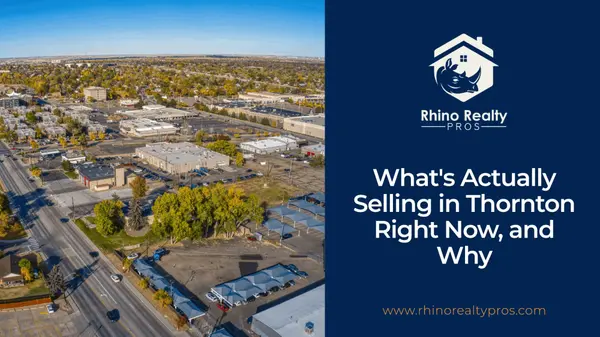
Thornton is Adams County's largest city — and one of the most consistently misunderstood cities in all of Metro Denver. Buyers who haven't spent time here tend to picture a featureless sprawl of cul-de-sacs somewhere north of Denver. What they find when they actually visit is a city with genuine neighborhood character, excellent infrastructure, meaningful lifestyle variety, and a value proposition that makes comparable Denver neighborhoods look unjustifiably expensive.
Rick Cavallaro and the team at Rhino Realty Pros work in Thornton constantly, and we've watched it evolve over the years into a city that genuinely rewards buyers who take the time to understand its different pockets. This guide breaks down Thornton neighborhood by neighborhood — what each area delivers, who it's right for, what it costs, and what the honest trade-offs are. Whether you're relocating to Metro Denver for the first time or moving north from Denver in search of value, this is the guide we wish every Thornton buyer had before they started their search.
Understanding Thornton's Layout
Thornton runs roughly north-to-south along the I-25 corridor, stretching from its southern border with Denver and Northglenn all the way to its northern edge near 144th Avenue and The Orchard Town Center. The city is wider than most buyers initially expect, extending east past Colorado Boulevard toward Riverdale Road and west toward Federal Heights and Westminster.
In general terms, southern Thornton is older — established neighborhoods from the 1970s, 80s, and 90s with mature trees, smaller lots, and more affordable prices. Northern Thornton is newer — larger homes, more recent construction, The Orchard retail corridor, and the light and open feel of planned development from the 2000s and 2010s. The N-Line light rail runs roughly through the city's center, providing a north-south transit spine that significantly affects how neighborhoods in its corridor function for commuters.
Neither older nor newer Thornton is objectively better — they suit different buyers and different life stages. What matters is understanding which pocket fits your specific priorities, because the experience of living in southern Thornton and northern Thornton can feel meaningfully different despite sharing a city name.
Thornton's Neighborhoods: An Honest Breakdown
North Thornton / The Orchard Corridor
North Thornton is the city's premium address — and for good reason. Homes here are newer (primarily 2000s–2010s construction), larger, and positioned within easy walking or biking distance of The Orchard Town Center, Thornton's open-air lifestyle retail and dining destination. This is the pocket of Thornton where walkability is most tangible, where street connectivity is best, and where buyers are paying the most — but getting the most in return.
Streets in this area are wide and well-maintained, parks are newer and well-equipped, and the density of retail and restaurant options within close range is the highest in the city. Adams 12 Five Star schools serving this area include newer facilities that reflect the neighborhood's relatively recent development. The Margaret W. Carpenter Recreation Center anchors community recreation for residents in this part of the city.
Best for: Buyers who prioritize walkability, newer construction, larger floor plans, and proximity to retail and dining. Move-up buyers and families who want the best of Thornton's amenities without paying Denver prices.
Eastlake / N-Line Corridor
The Eastlake corridor runs through Thornton's midsection, anchored by Eastlake itself — a genuine lake that provides wildlife habitat, walking paths, and the kind of natural backdrop that most suburban neighborhoods lack entirely. The N-Line light rail stations in this corridor connect residents directly to Union Station and downtown Denver, making this Thornton's most transit-connected neighborhood zone.
Homes here cover a wider range of vintages than the north Thornton corridor — you'll find well-maintained homes from the 1980s and 90s alongside newer infill development that has materialized around the light rail stations. The combination of lake access, trail connectivity, and transit proximity makes this corridor appealing to a diverse range of buyers: commuters, outdoor enthusiasts, and buyers who want nature and urban connectivity in one package at a price point well below north Thornton.
Best for: Commuters who want to avoid daily I-25 driving. Buyers who value natural amenities and trail access. Budget-conscious buyers seeking maximum location efficiency — transit plus lake plus solid neighborhood.
Central Thornton / 120th–136th Ave
Central Thornton is the city's established core — neighborhoods developed primarily in the 1980s and 1990s with mature trees, larger lots relative to price, and a settled neighborhood character that newer developments haven't had time to develop. These streets feel lived-in in the best sense: neighbors know each other, yards are landscaped, and the housing stock — while older — has generally been maintained and in many cases significantly updated.
The 136th Avenue commercial corridor runs through this zone, providing grocery anchors, everyday retail, and casual dining within reasonable reach for most residents. Access to both I-25 and the N-Line is good from this area, and the price-to-space ratio is arguably Thornton's best — buyers willing to purchase and potentially update a home from this era get significantly more square footage and lot size per dollar than anywhere in north Thornton.
Best for: Value-focused buyers willing to do some updating. Buyers who prefer mature neighborhood character over new construction feel. First-time buyers stretching their budget. Buyers who want large lots without paying a premium.
South Thornton / Thornton Parkway Area
South Thornton sits directly on the border with Denver and Northglenn, making it one of the most Denver-accessible parts of the city. Homes here are among Thornton's oldest — many from the 1960s and 70s — and prices reflect that vintage. For buyers who want to be as close to Denver as possible while still benefiting from Thornton's lower price points and Adams 12 schools, south Thornton delivers the geographic position at the city's most accessible price point.
This part of the city has seen genuine reinvestment as buyers from Denver have discovered the value. Renovated ranches and split-levels are increasingly common, and the neighborhood's proximity to Denver's commercial infrastructure — accessible without getting on I-25 — makes it genuinely convenient for everyday life. Big Dry Creek Trail connectivity runs through portions of this area, adding a recreational dimension that the neighborhood's density might not suggest.
Best for: Buyers who want to be as close to Denver as possible within Thornton's price structure. First-time buyers and investors looking for value-add properties. Buyers comfortable with older housing stock who see the equity opportunity.
Thornton's Eastern Neighborhoods / Riverdale Corridor
Thornton's eastern neighborhoods — those east of Colorado Boulevard toward the Riverdale Road corridor — offer a noticeably different character from the city's I-25 spine. Streets are quieter, lot sizes are frequently larger, and the lower density creates a more open, suburban feel that some buyers strongly prefer over the busier western corridors. Homes here span a range of eras and styles.
The trade-off for the additional space and quiet is a longer drive to retail destinations and I-25 access. But for buyers who work from home, or whose daily routine doesn't require frequent highway trips, the eastern neighborhoods represent genuine value — more space, lower prices, and a neighborhood texture that is noticeably calmer than Thornton's busier western half.
Best for: Remote workers who prioritize space and quiet over commute convenience. Buyers who want larger lots at lower prices. Buyers with children who want less traffic density on their street.
Schools: What Adams 12 Five Star Delivers in Thornton
The entire city of Thornton falls within the Adams 12 Five Star School District — one of the strongest school districts in Adams County and a genuine asset for family buyers. Adams 12 operates multiple elementary, middle, and high school options across the city, and the quality of facilities has improved consistently as the district has reinvested in its buildings and programming.
Thornton's high schools include Thornton High School, Mountain Range High School, and Legacy High School (which sits in the Westminster/north Thornton area). Each school has a distinct culture and program emphasis — Thornton High is the district's oldest and most established; Mountain Range has strong athletics and a large, modern campus; Legacy has an academic reputation and serves north Thornton and Westminster families. Which high school a home feeds into matters to some buyers, and Rick Cavallaro and Rhino Realty Pros always verify exact school boundaries for every property before advising clients with school-age children.
Elementary and middle school quality in Thornton is generally strong and consistent across the district, with some variation. Buyers with children in specific grade levels are encouraged to research individual school performance, after-school programming, and magnet or charter options within the district rather than relying solely on district-level generalizations.
Getting Around: Thornton's Transportation Reality
Thornton's transportation picture has improved significantly with the N-Line light rail, but the honest reality is that most Thornton residents drive for the majority of their daily needs. I-25 is the city's primary artery, and rush-hour southbound congestion toward Denver is real — typically 20–30 minutes in normal conditions, longer on bad weather days or when incidents occur. Buyers who commute to downtown Denver daily should test the drive at their actual commute time before committing to a specific neighborhood.
The N-Line stations change the math for riders willing to use transit. A park-and-ride commute to Union Station via N-Line typically takes 35–45 minutes door-to-door from most Thornton neighborhoods — slower than a car on a good day, but immune to traffic and significantly less stressful. For buyers considering hybrid or occasional commuting to Denver, the N-Line is worth factoring into neighborhood selection.
US-36 to Boulder is accessible from Thornton's western edge in approximately 25–30 minutes. DIA is 25–35 minutes from most Thornton neighborhoods. E-470 access from Thornton's eastern edge opens the full range of southeastern Metro Denver destinations without touching I-25 — valuable for buyers whose employers or family are south and east of the city.
Parks, Recreation, and Outdoor Life in Thornton
Thornton's parks and recreation system is one of the city's most underappreciated assets. The Margaret W. Carpenter Recreation Center in north Thornton is a full-service facility with pools, fitness equipment, group fitness classes, and extensive youth programming. Community recreation centers and neighborhood pools are distributed throughout the city, meaning most residents are within reasonable reach of organized recreation regardless of which neighborhood they're in.
The Big Dry Creek Trail is Thornton's most significant outdoor asset — a regional trail corridor that winds through the city and connects to a broader Adams County trail network, providing a car-free path for running, biking, and walking. Eastlake adds wildlife viewing, fishing, and lakeside walking. And Thornton's neighborhood parks — distributed throughout the city with generally high maintenance standards — provide play areas, sports fields, and green space that families use daily.
The Honest Comparison: Thornton vs. Denver
Buyers considering Thornton versus staying in Denver need an honest comparison, not a sales pitch. Thornton does not have Denver's restaurant and bar density, its gallery scene, its pedestrian street energy, or its proximity to the mountains via I-70. If those are your primary lifestyle priorities, Thornton is not the right answer for you — and saying otherwise would be a disservice.
What Thornton does offer is more home for significantly less money, a stronger school district than most Denver neighborhoods, better recreation infrastructure at lower cost, easier parking and lower daily stress, and a community feel that urban density often works against. For buyers in their thirties and forties with families or family plans, for remote workers who value space over proximity to a nightlife scene, and for buyers who have done the financial math and understand what the gap between Thornton and Denver pricing means for their long-term wealth — the comparison resolves clearly in Thornton's favor.
Families with children who prioritize Adams 12 schools and park access. Commuters who want I-25 or N-Line access to Denver without Denver prices. Remote workers seeking larger homes and quieter streets. First-time buyers who want value, space, and a real yard. Move-up buyers from south Thornton or Northglenn seeking more home in the same market. Buyers relocating from out of state who want a complete suburban lifestyle at genuine value. Anyone who has run the numbers and understands that $150,000–$250,000 less than a comparable Denver home is a life-changing financial difference.
What Buyers Are Most Surprised By in Thornton
Rick Cavallaro and Rhino Realty Pros take a lot of buyers through Thornton who have done their research online but haven't spent time in the city in person. The surprises are consistent. The mountain views — on a clear day, the Front Range is dramatically visible from elevated lots throughout the city, and the sunsets over the Rockies from a north Thornton backyard are genuinely spectacular. The quality of the parks — Thornton's recreation investment is better than its reputation suggests, and buyers from Denver are often impressed by what they find. The neighborhood feel — specific pockets of Thornton have strong block-level community character that surprises buyers who expected generic suburban anonymity. And the commute — buyers who test the I-25 drive or the N-Line often find it less painful in practice than they feared in theory.
What to Look for When Touring Thornton Homes
A few practical notes for buyers actively searching in Thornton. In older south and central Thornton neighborhoods, prioritize inspecting roofs, HVAC systems, and windows — these are the components most likely to need attention in homes from the 1970s–90s, and budgeting for them accurately is important for total cost of ownership. In north Thornton's newer construction, ask specifically about metro district obligations and HOA covenants, which can add meaningful cost and constraint that aren't visible in the list price. Throughout the city, verify school boundaries for specific addresses rather than assuming based on neighborhood location — boundaries shift and aren't always intuitive.
And in any Thornton neighborhood, visit on a weekday rather than just a weekend. Thornton's daytime community energy — neighbors out, parks in use, retail corridors busy — is part of what makes its best pockets genuinely livable rather than just geographically convenient. The city shows well when it's operating, not just when it's quiet.
The Bottom Line on Thornton
Thornton rewards buyers who take the time to understand it. It is not one neighborhood — it is a collection of distinct pockets, each with its own character, price point, and lifestyle profile. The buyer who belongs in north Thornton near The Orchard is a different buyer than the one who belongs in the Eastlake corridor or the value-rich central neighborhoods. Matching the right buyer to the right part of the city is exactly the work that matters most in a market like this.
Rick Cavallaro and the team at Rhino Realty Pros know Thornton's neighborhoods deeply — the streets that over-deliver on value, the pockets worth waiting for, and the specific blocks where lifestyle, school access, trail connectivity, and price converge in the buyer's favor. If Thornton is on your list, let's make sure you end up in the right part of it.
Ready to Find Your Neighborhood in Thornton?
Contact Rick Cavallaro and Rhino Realty Pros today. We'll walk you through Thornton's neighborhoods honestly, match your priorities to the right area of the city, and help you find a home that delivers on every level — value, lifestyle, schools, and commute. Thornton has more to offer than most buyers expect. Let us show you.
Schedule Your Thornton Neighborhood TourCategories
Recent Posts