Where to Live in Thornton for Walkability, Convenience, and Value
Where to Live in Thornton for Walkability, Convenience, and Value
When most people think of walkable neighborhoods in Metro Denver, their minds go straight to Cherry Creek, Highland, or Washington Park — beautiful areas where the ability to walk to dinner, coffee, and groceries is baked into eye-watering home prices. What fewer buyers realize is that Thornton has quietly developed pockets of genuine walkability — and is delivering that lifestyle at a fraction of the cost. Rick Cavallaro and the team at Rhino Realty Pros are having this conversation with buyers every week right now, and the reaction is almost always the same: they had no idea Thornton offered this.
This isn't about pretending Thornton is Denver's next RiNo. It's about being clear-eyed and honest: specific pockets of Thornton — particularly those surrounding The Orchard Town Center and the city's most developed commercial corridors — offer a genuinely car-light lifestyle for everyday errands, dining, and recreation at prices that make comparable Denver walkability look completely out of reach. For buyers who want convenience without the premium, here's what you need to know.
The Walkability Gap Between Thornton and Denver
Let's put real numbers on the comparison. A walkable home in Denver's Highlands neighborhood — where you can stroll to coffee shops, restaurants, boutiques, and Sloan's Lake — will cost you somewhere between $700,000 and $1.2 million in 2026 for a modest single-family home. Cherry Creek walkability starts even higher. Washington Park properties with genuine pedestrian access to shops and dining regularly exceed $900,000.
In Thornton's most walkable pockets — neighborhoods within easy reach of The Orchard Town Center, major grocery anchors, restaurants, and trail access — comparable single-family homes are selling in the $430,000–$620,000 range. That gap, often $300,000 or more for similar walkability functionality, is not a small thing. It's the difference between a starter home and a forever home. It's the difference between stretching uncomfortably and buying with real financial margin. For buyers who have been telling themselves walkability requires Denver prices, Thornton is a genuinely important reality check.
Denver Highlands (walkable): $700,000–$1,200,000. Denver Cherry Creek (walkable): $850,000–$1,500,000+. Denver Washington Park (walkable): $750,000–$1,100,000. Thornton near Orchard Town Center: $430,000–$620,000. Thornton near 144th Ave corridor: $410,000–$580,000. Thornton near Eastlake/light rail: $400,000–$560,000. Savings vs. comparable Denver walkability: $250,000–$500,000+.
The Orchard Town Center: Thornton's Walkability Anchor
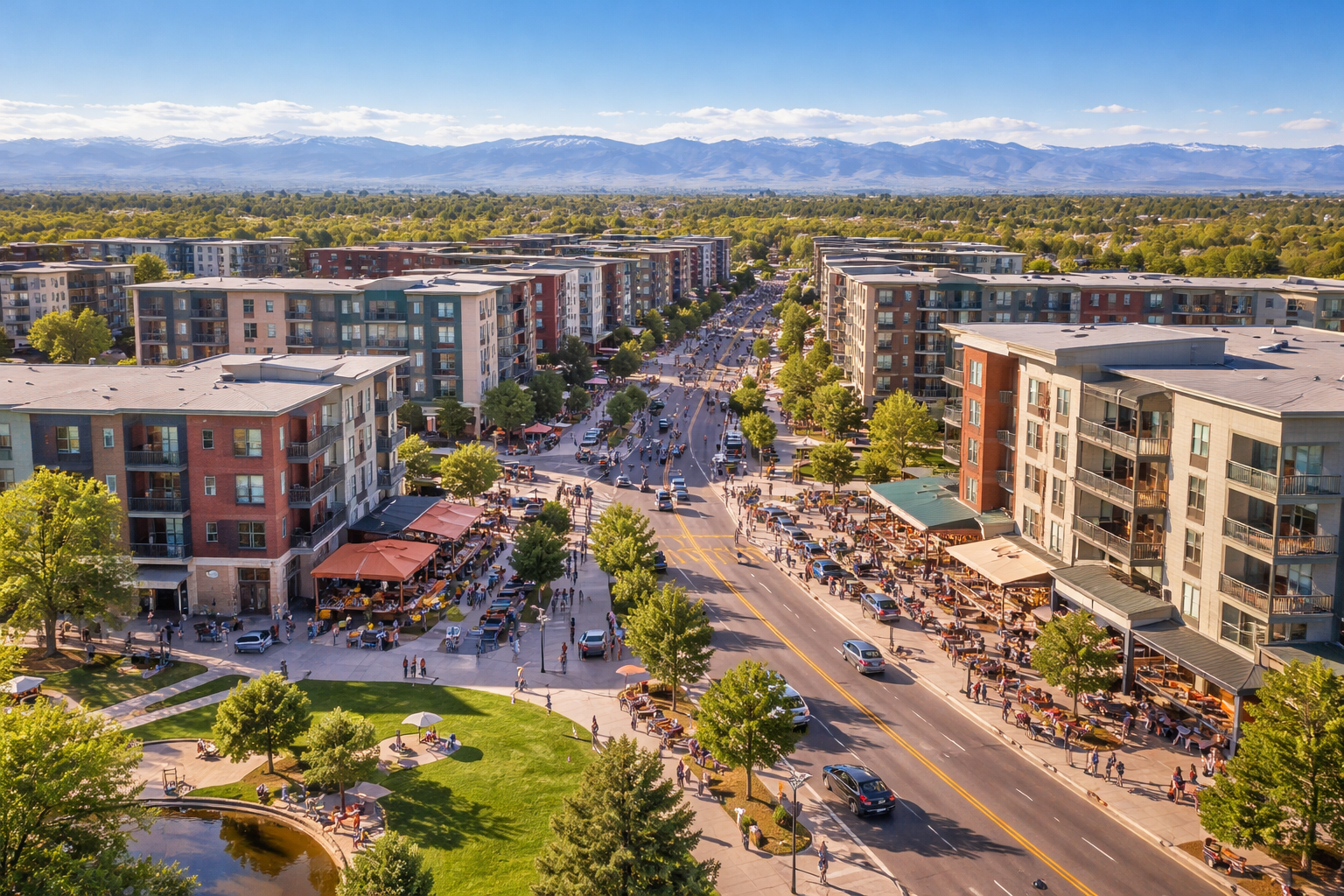
The Orchard Town Center at 144th Avenue is the centerpiece of Thornton's walkable lifestyle story. This isn't a typical suburban strip mall — it's an open-air, mixed-use town center designed with pedestrian circulation in mind. Restaurants, national retailers, a movie theater, fitness options, specialty shops, and multiple grocery-anchored adjacent centers have created a genuine destination that neighborhoods to its east and west can access without a car.
The design philosophy behind The Orchard was intentional: create a town square feel in a suburban setting. Walking paths connect retail sections. Outdoor dining creates street-level energy. The mix of everyday necessity retailers — grocery, pharmacy, coffee, casual dining — alongside entertainment options means residents nearby are genuinely running the majority of their errands and leisure activities on foot or by bike rather than exclusively by car.
For buyers who have been told they need to pay Denver prices to escape complete car dependence, The Orchard corridor is proof that isn't true. The question is simply knowing which neighborhoods are positioned to take full advantage of it.
What You Can Reach on Foot or by Bike from The Orchard Area
Residents in the neighborhoods immediately surrounding The Orchard Town Center have walkable or bikeable access to a full-service grocery store, multiple casual and sit-down dining options, a movie theater, fitness studios, coffee shops, a pharmacy, and specialty retail. For everyday life — the grocery run, the dinner out, the Saturday morning coffee — this covers the vast majority of what families actually do week to week. That's genuine walkability, not a marketing term.
The Neighborhoods That Benefit Most
Thornton is a large city, and walkability varies significantly by location. The neighborhoods that deliver the best combination of pedestrian convenience and housing value are concentrated in specific pockets. Here's where Rick Cavallaro and Rhino Realty Pros are directing buyers who prioritize this lifestyle.
The Orchard Surrounding Neighborhoods (144th Ave Corridor)
The neighborhoods clustered within a half-mile to one mile of The Orchard Town Center represent Thornton's clearest walkability value. Homes here — a mix of newer construction from the 2000s and 2010s alongside some updated older stock — are positioned to take full advantage of the town center on foot. Streets were designed with sidewalk connectivity in mind, and the relatively flat terrain makes biking a genuinely practical option for most residents.
Prices in this pocket range from approximately $450,000 to $620,000 in spring 2026. Homes tend to be well-maintained, family-oriented, and sit on reasonable lot sizes. The neighborhood has an active, established feel — not a brand-new community still waiting for its commercial base to develop, but a fully built-out area where the amenities are already in place and being used daily.
Eastlake Corridor and Light Rail Adjacent Neighborhoods
Thornton's Eastlake area and the neighborhoods surrounding the N-Line light rail stations offer a different but equally compelling walkability story. Here, the convenience isn't just about local errands — it's about getting to downtown Denver, Union Station, and points along the entire RTD N-Line corridor without touching a car. For households with one car, or buyers who want to reduce transportation costs meaningfully, light rail adjacency in Thornton delivers real urban connectivity at suburban prices.
Homes near Thornton's light rail stations typically range from the low $400s to the mid-$500s, making them some of the most accessible transit-oriented properties in the entire Metro Denver market. The surrounding retail and dining that has developed along these corridors adds pedestrian convenience on top of the transit access, creating a layered walkability that works for both daily errands and broader metro connectivity.
The 136th Avenue Commercial Corridor Neighborhoods
Neighborhoods adjacent to Thornton's 136th Avenue corridor benefit from a dense concentration of everyday retail — grocery anchors, pharmacies, fast casual dining, and service businesses that cover the routine needs of family life. While less intentionally designed as a walkable destination than The Orchard, the sheer density of convenient retail along this corridor means that residents within a reasonable radius are making fewer car trips than their counterparts in Thornton's more residential-only neighborhoods.
Home prices in this area are often slightly more accessible than the Orchard corridor, ranging from the high $300s to the mid-$500s, making it a strong target for first-time buyers and those prioritizing maximum value alongside everyday convenience.
Margaret W. Carpenter Recreation Center Area
The neighborhoods surrounding the Margaret W. Carpenter Recreation Center in central Thornton benefit from both recreational walkability and proximity to the commercial development along nearby corridors. The recreation center itself — one of the best-equipped facilities in Adams County — adds a lifestyle dimension to walkability that goes beyond retail. Families in these neighborhoods can access fitness, pools, youth programming, and community events without a car, creating a daily rhythm of activity that closely mirrors what draws buyers to Denver's most desirable neighborhoods at far lower price points.
Walkability Beyond Errands: Parks and Trails
Thornton's walkability story isn't limited to retail convenience. The city has invested meaningfully in its parks and trail network, and the neighborhoods that sit near both commercial amenities and green space represent the strongest overall lifestyle value in the city. The Big Dry Creek Trail, which runs through multiple Thornton neighborhoods, connects residents to a regional trail network that extends well beyond city limits.
For buyers who define walkability broadly — not just getting to a coffee shop, but getting to a trail, a park, a rec center, and a grocery store without defaulting to a car for every trip — Thornton's best-positioned neighborhoods check all of those boxes simultaneously. That combination, at Thornton price points, is genuinely rare in Metro Denver.
Grocery store within 0.5–1 mile. Multiple dining options within walking or biking distance. Coffee shop access without a car trip. Trail or park within a 10-minute walk. Recreation center within a reasonable bike ride. Light rail access for Denver commuting (Eastlake corridor). Sidewalk-connected streets with practical pedestrian infrastructure. Flat-to-gentle terrain that makes biking realistic year-round.
The Honest Trade-Offs
Being straightforward matters more than a sales pitch. Thornton's walkable pockets are real, but they are not equivalent to Denver's most walkable neighborhoods in every dimension. The density of independently owned restaurants, boutique retail, and the kind of spontaneous street-level energy you find in RiNo or Highlands is not present in Thornton at the same level. If that specific urban texture is what you're seeking, Thornton is not going to deliver it and it's worth being upfront about that.
What Thornton does deliver is functional walkability — the ability to live a genuinely car-light life for the practical business of daily living — alongside suburban space, good schools, strong parks, and home prices that allow you to build equity rather than simply tread water in an expensive market. For buyers whose priorities are practical convenience, financial margin, and quality family living rather than urban density for its own sake, that trade is an excellent one.
Who Thornton's Walkable Pockets Are Right For
The buyers Rick Cavallaro and Rhino Realty Pros see gravitating toward Thornton's walkable neighborhoods tend to share a few characteristics. They've been priced out of the Denver neighborhoods they originally targeted and are recalibrating around value rather than zip code prestige. They have families or are planning them, and practical daily convenience matters more than nightlife proximity. They're financially thoughtful — they see the $300,000+ gap between Thornton and comparable Denver walkability and understand what that difference means for their long-term financial picture. And increasingly, they're buyers who have done the math on commuting costs and discovered that Thornton's light rail access makes the distance from downtown Denver much smaller in practical terms than it looks on a map.
Spring 2026: The Right Time to Act
Spring inventory in Thornton's walkable pockets moves efficiently. The neighborhoods near The Orchard Town Center and the light rail corridor have a consistent base of informed buyers who know their value, and well-priced homes in prime walkability positions don't sit long. March and April bring fresh listings as sellers emerge from winter, creating the best selection window of the year — but also the most competitive buyer environment.
Getting pre-approved, knowing exactly which streets and blocks deliver the walkability you're looking for, and being ready to move decisively when the right home appears is how buyers succeed in this market. That's exactly the kind of preparation Rick Cavallaro and Rhino Realty Pros help clients with — not just identifying the right neighborhood, but positioning you to actually get the home you want once you find it.
The Bottom Line: Thornton's Walkability Is Real and Underpriced
The walkability gap between what Thornton delivers and what buyers are paying for it remains one of the most interesting value opportunities in Metro Denver right now. Specific pockets of the city — particularly surrounding The Orchard Town Center, along the light rail corridor, and near the city's major recreation and commercial anchors — offer a genuinely car-light daily lifestyle at prices that are hundreds of thousands of dollars below comparable Denver neighborhoods.
For buyers who have convinced themselves that walkability requires Denver prices, a tour of Thornton's best pockets has a way of changing that calculus quickly. The coffee shop is there. The grocery store is there. The trail is there. The rec center is there. The price tag is just dramatically different.
Rick Cavallaro and the team at Rhino Realty Pros know Thornton's walkable neighborhoods in detail — which streets genuinely deliver on the promise, where the best values are hiding right now, and how to position you as a buyer to get the home that matches your lifestyle. Let's find it together this spring.
Ready to Explore Thornton's Most Walkable Neighborhoods?
Contact Rick Cavallaro and Rhino Realty Pros today. We'll show you the specific Thornton pockets that deliver real walkability and real value, compare your options honestly, and help you find a home that fits your lifestyle without the Denver price tag. Let's make spring 2026 the season you stop overpaying for convenience.
Schedule Your Thornton Walkability ConsultationCategories
Recent Posts