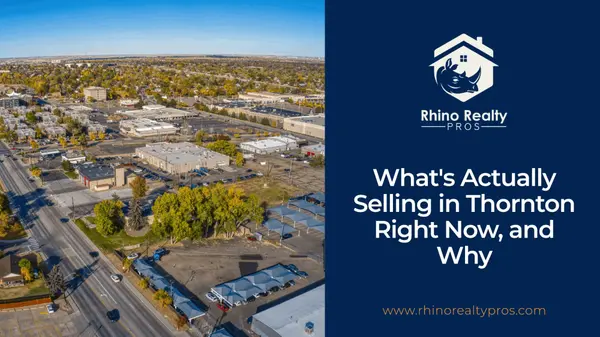
Why Brighton Keeps Growing Faster Than Its Neighbors
Why Brighton Keeps Growing Faster Than Its Neighbors

Rhino Realty Pros has watched Brighton show up in more buyer searches every year, and Rick Cavallaro isn't surprised — the numbers back up what buyers are noticing on the ground. Brighton isn't just growing; it's growing meaningfully faster than the Adams County cities around it. Here's the actual data behind that, and what's driving it.
The Numbers Don't Lie
Brighton's population sits at roughly 46,320 in 2026, up 15% since the 2020 census count of 40,280 — a growth rate of about 2.04% annually. Compare that to Thornton, the county's largest city, projected at 147,271 in 2026 with an annual growth rate closer to 1.1%, or Northglenn, projected at 39,066 with growth closer to 0.44%. Put simply, Brighton is currently growing at roughly double Thornton's pace and more than four times Northglenn's.
1. Room to Build That Its Neighbors No Longer Have
Thornton and Northglenn are largely built out — most available residential land within their borders has already been developed. Brighton, by contrast, still has meaningful undeveloped and agricultural land within and around city limits, giving builders room to add new subdivisions without the site-assembly and infill challenges that slow growth in more mature suburbs. The city has leaned into this directly through its "Agriburbia" land use approach, blending rural land use principles into new urban development rather than treating agricultural land purely as something to pave over.
2. Jobs Are Growing Locally, Not Just Housing
The Local Economy
Brighton is home to roughly 1,300 businesses employing over 17,000 people, with an additional 2,700 jobs created in the past year alone.
Population growth that outpaces job growth tends to produce a bedroom community with long commutes and thinner local tax bases. Brighton's job numbers suggest something different is happening: local employment is expanding alongside housing, which supports the kind of retail, restaurant, and service growth that makes a city more self-sufficient rather than purely a commuter suburb of Denver.
3. Household Incomes Are Outpacing the State Average
Income and Affordability
Brighton's median household income is $107,679, about 10% higher than Colorado's statewide median, while the median value of owner-occupied homes sits at $475,100.
That combination — above-average household income paired with home values that remain competitive with the broader metro — is a big part of Brighton's draw. Families priced out of, or unwilling to pay a premium for, more built-out suburbs closer to Denver are finding a city where the math works better, without giving up income potential in the process. Brighton's homeownership rate of 71% also points to a community of long-term residents rather than a transient rental market.
Population: ~46,320 in 2026, up 15% since the 2020 census.
Growth rate: 2.04% annually — roughly double Thornton's and 4x+ Northglenn's.
Jobs: 1,300+ local businesses, 17,000+ employees, +2,700 jobs in the past year.
Income: $107,679 median household income, ~10% above the Colorado average.
Housing: $475,100 median home value, 71% homeownership rate.
Sources: World Population Review, Brighton and Northglenn population data (2026); City of Brighton, Community & Economic Development data; Colorado Demographics, Thornton population projections; Brighton Economic Development Corporation.
What This Means If You're Buying or Selling
For buyers, Brighton's growth trajectory is worth weighing seriously if long-term appreciation matters to you — a city adding jobs and population faster than its neighbors, with land still available for new development, tends to see sustained demand rather than a short-term spike. For sellers, it means the buyer pool looking at Brighton specifically is likely to keep expanding rather than plateauing, which is a meaningfully different position than a fully built-out suburb where growth has already leveled off.
Frequently Asked Questions
How much faster is Brighton growing than Thornton?
Brighton's current annual growth rate is about 2.04%, compared to roughly 1.1% for Thornton — meaning Brighton is growing at close to double Thornton's pace.
Why does Brighton have more room to grow than Thornton or Northglenn?
Thornton and Northglenn are largely built out, with most available residential land already developed. Brighton still has meaningful undeveloped and agricultural land within and around its city limits, giving builders more room for new subdivisions.
Is Brighton's growth just housing, or is the local economy growing too?
Both. Brighton added roughly 2,700 jobs in the past year and is now home to over 1,300 businesses employing more than 17,000 people, suggesting local employment is expanding alongside the population rather than lagging behind it.
Is Brighton more affordable than Thornton or Northglenn?
Brighton's median home value is $475,100, remaining competitive with the broader Denver metro, while its median household income of $107,679 runs about 10% above the Colorado state average — a combination that has made it attractive to buyers being priced out of more built-out suburbs.
Curious What Brighton's Growth Means for Your Buying or Selling Timeline?
I'll walk you through what's actually driving demand in Brighton right now and how it compares to the neighborhoods you're considering.
Schedule a ConsultationCategories
Recent Posts